Does Calcium Block Iron Absorption? A Practical Timing Guide
Quick Answer: Calcium does inhibit iron absorption, but the effect is smaller and shorter-lived than commonly claimed, and it appears to matter far less over a full day than in single-meal studies. The practical rule: if you take an iron supplement, keep calcium supplements and large dairy servings about two hours away from it. For food iron in ordinary meals, don’t rearrange your diet — total intake and vitamin C matter considerably more.
The advice circulating is that dairy blocks iron, so never eat them together. Which would rule out a great many perfectly good meals.
The real picture is more forgiving, and the part worth acting on is narrower than you’d think.

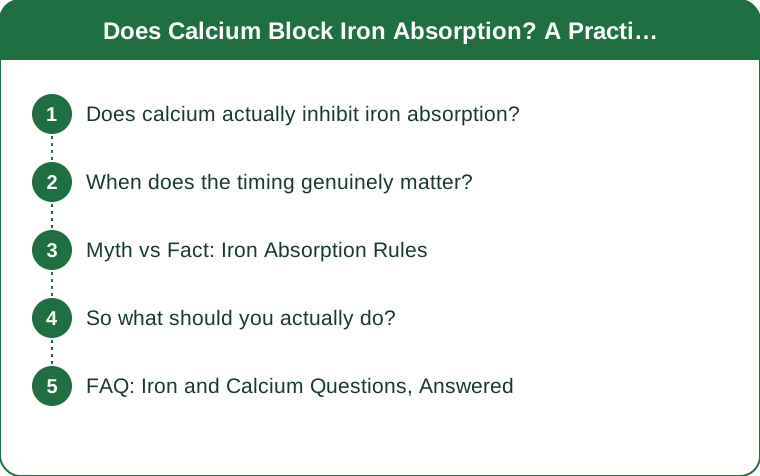
Does calcium actually inhibit iron absorption?
Yes, and it’s genuinely unusual in one respect: calcium is the only known dietary factor that inhibits both heme iron (from meat) and non-heme iron (from plants and supplements). Most inhibitors — tea polyphenols, phytates in grains and legumes — only affect non-heme.
Single-meal studies have shown meaningful reductions in iron absorption when substantial calcium is consumed alongside — the effect is real and measurable. The exact mechanism isn’t fully settled, but it appears to happen at the level of intestinal cell transport rather than through binding in the gut.
Here’s the important qualifier. Longer-term studies looking at total iron status over weeks and months have consistently found much smaller effects than the single-meal work suggests — and often no meaningful effect on iron status at all.
The likely explanation is adaptation: absorption efficiency adjusts over time, and the body appears to compensate across the day for what a single meal blocked. This is a general pattern in nutrition research, and it’s why single-meal absorption studies routinely overstate real-world impact.
What this means practically: the effect is real enough to work around when it’s cheap to do so, and not real enough to reorganize your diet around.
When does the timing genuinely matter?
Three situations, and the rest of the time it doesn’t.
If you’re taking an iron supplement. This is the clearest case. Supplemental iron is a large dose delivered at once, you’re taking it specifically to correct a deficit, and the timing costs you nothing to get right. Keep calcium supplements and large dairy servings about two hours away.
If you’re treating diagnosed iron deficiency. Same logic, higher stakes. When you’re rebuilding depleted stores, small absorption differences accumulate over months of supplementation. This is worth being deliberate about.
If your calcium intake is very high and your iron intake is marginal. Someone consuming large amounts of dairy and calcium supplements while eating little iron-rich food is in the situation where the interaction could plausibly matter. Even here, the more useful fix is increasing iron intake rather than reducing calcium.
When it doesn’t matter: ordinary mixed meals. Cheese on a burger, milk in your coffee alongside a spinach omelette, yogurt with breakfast. Total iron intake over the week and the presence of vitamin C both do considerably more for your iron status than separating these ever will.

Myth vs Fact: Iron Absorption Rules
Myth: You should never eat dairy and iron-rich foods in the same meal. Fact: For food iron in normal amounts, this is over-applied. Long-term studies don’t support meaningful harm to iron status. Reserve the separation for supplements.
Myth: Coffee is the biggest iron blocker. Fact: Coffee and tea polyphenols do inhibit non-heme iron absorption substantially, and tea is generally the stronger inhibitor of the two. But neither affects heme iron, and both are easy to move — an hour either side of an iron-rich meal handles it.
Myth: Vitamin C only helps a little. Fact: Vitamin C is the strongest practical enhancer available and can substantially increase non-heme iron absorption from the same meal. It also counteracts inhibitors. This is by far the highest-value thing on this page.
Myth: Taking iron on an empty stomach is always best. Fact: Absorption is better on an empty stomach, but so is nausea — and the supplement you stop taking absorbs nothing. If empty-stomach dosing is intolerable, taking it with a small non-dairy snack and some vitamin C is a good trade.
Myth: Daily iron supplementation beats alternate-day. Fact: Evidence suggests alternate-day dosing may actually improve total absorption, because a large dose raises hepcidin — a hormone that suppresses iron uptake — for roughly 24 hours afterward. Ask your doctor about this if you’re supplementing; it’s a genuine change from the older advice.
Myth: Cooking in cast iron meaningfully treats deficiency. Fact: It adds a small amount of iron, particularly with acidic foods, but the amounts are inconsistent and modest. It’s a marginal contribution, not a treatment.
So what should you actually do?
If you take an iron supplement:
- Take it at a time separated by about two hours from calcium supplements, large dairy servings, tea, and coffee
- Take it with a vitamin C source — a small glass of orange juice, or a vitamin C tablet
- Ask your doctor about alternate-day dosing, which may absorb better than daily
- Between meals is ideal if you tolerate it; with a small non-dairy snack if you don’t
- Many people find bedtime works well, since it’s naturally distant from dairy-containing meals
If you’re relying on food iron:
- Pair non-heme iron sources with vitamin C at the same meal — this does more than any avoidance strategy. Lentils with tomatoes, spinach with lemon, beans with peppers
- Include some heme iron if you eat meat; it absorbs far better and improves absorption of non-heme iron eaten alongside it
- Move tea and coffee an hour away from your most iron-rich meal, since these are stronger inhibitors than calcium and easier to shift
- Don’t restructure meals to avoid dairy. The cost isn’t worth the benefit
If you’re deficient: timing optimization is a supporting detail. The main interventions are adequate supplementation at the right dose, finding and addressing the cause of the loss, and enough time — rebuilding iron stores typically takes several months, well beyond the point where blood counts normalize.
This is general information, not medical advice. Don’t start iron supplements without testing — iron overload is genuinely harmful, and fatigue has many causes besides low iron. If you have heavy periods, are vegetarian or vegan, or train heavily in endurance sport, ask your doctor about testing ferritin alongside hemoglobin.
FAQ: Iron and Calcium Questions, Answered
Can I have milk in my coffee if I’m eating an iron-rich breakfast?
The coffee matters more than the milk. If the meal is your main iron source of the day, move the coffee to an hour later. If it’s an ordinary breakfast among many, don’t worry about either.
What about a post-workout protein shake with iron-rich dinner?
Whey is dairy-derived and contains calcium, but a shake and dinner are usually separated by enough time anyway. If they overlap and you’re actively treating a deficiency, space them by an hour or two. Otherwise it’s not worth managing.
I take a multivitamin with both iron and calcium. Is that pointless?
Not pointless, but the iron in it is less well absorbed than iron taken separately. If you’re addressing a diagnosed deficiency, a dedicated iron supplement taken away from calcium is a better approach. For general maintenance, a multivitamin is fine.
How long until better absorption shows in a blood test?
Hemoglobin often responds within a few weeks, but ferritin — which reflects stored iron — takes considerably longer, typically three to six months of consistent supplementation. Stopping when you feel better is the most common reason deficiency recurs.
TL;DR:
- Calcium does inhibit iron absorption — uniquely, both heme and non-heme — but long-term studies show far smaller effects on iron status than single-meal research suggests.
- Separate calcium from iron supplements by about two hours. Don’t rearrange ordinary meals around food iron.
- Vitamin C is the highest-value move available and can substantially increase non-heme absorption.
- Tea and coffee are stronger inhibitors than calcium, and easier to shift.
- Ask your doctor about alternate-day supplement dosing — it may absorb better than daily.
If you’re supplementing, the change worth making today is adding a vitamin C source to the dose. It does more than every avoidance rule on this page combined.
Keep Reading
This article is for general informational purposes only and is not medical advice. Always consult a qualified health professional for guidance specific to you.