Iron and Restless Legs at Night: The Connection Worth Testing For
Quick Answer: Low brain iron is one of the strongest known contributors to restless legs syndrome, and the threshold that matters is far higher than the one used to diagnose anaemia. Guidelines commonly recommend considering iron treatment when ferritin is below about 75 micrograms per litre — a level most labs report as normal. Ask specifically for ferritin and transferrin saturation, not just a full blood count.
This is general information, not medical advice.

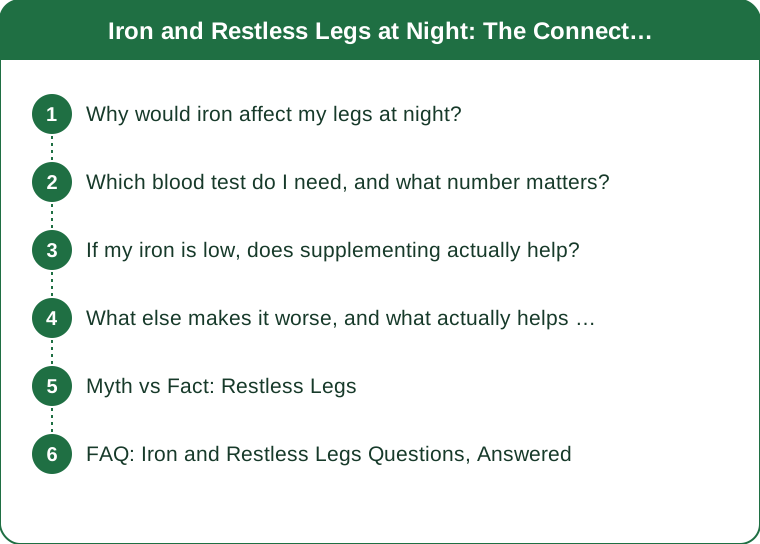
Why would iron affect my legs at night?
Iron is required to make dopamine. The enzyme that produces dopamine depends on iron as a cofactor, and dopamine signalling in the brain is central to how restless legs syndrome develops. Low iron in the relevant brain regions means impaired dopamine function, and the symptoms follow.
Brain iron and blood iron are not the same thing. You can have entirely normal circulating iron and still have insufficient iron reaching the brain regions involved, which is why people are so often told their bloods are fine while their symptoms are anything but.
Dopamine has a daily rhythm and it falls in the evening. That is why symptoms are overwhelmingly worse at night and largely absent in the morning, and it is one of the most distinctive features of the condition.
Movement temporarily relieves it, rest brings it back. This is the defining pattern. Symptoms that are constant, or that do not improve with movement, point somewhere else and are worth investigating differently.
And it is common, particularly in women. Restless legs syndrome affects a meaningful percentage of adults, is roughly twice as common in women, and rises further in pregnancy and with age. Many people live with it for years without ever mentioning it to anyone.
Which blood test do I need, and what number matters?
Ask for ferritin and transferrin saturation specifically. A standard full blood count checks haemoglobin and will look completely normal in someone whose iron stores are depleted but who is not yet anaemic.
The threshold for restless legs is much higher than for anaemia. Many labs flag ferritin as low only below about 15 or 30 micrograms per litre. Clinical guidance for restless legs commonly suggests considering iron treatment when ferritin sits below roughly 75, and transferrin saturation below about 20 percent.
This is the single most useful thing to know about the condition, because it explains why so many people are told there is nothing wrong. The test was not abnormal by the criteria being applied; it was simply not the criteria that matter here.
Time the test properly. Ferritin rises with inflammation and infection, so a test taken during an illness can look reassuringly high while stores are actually low. Morning, fasted, and not during an infection gives the most interpretable result.
Ask for the actual number rather than accepting normal. Where you sit within the reference range is the entire question, and the word normal discards exactly the information you need.
And mention the symptoms explicitly when you ask. A ferritin result is interpreted very differently by a clinician who knows you are describing an evening urge to move your legs than by one processing a routine screen.
If my iron is low, does supplementing actually help?
In people with low ferritin, oral iron has reasonable evidence for improving symptoms — but it works slowly and it does not work for everyone.
Expect to wait. Rebuilding stores takes months rather than weeks, and symptom improvement typically trails the blood numbers. Three months is a realistic point at which to reassess rather than three weeks.
Absorption is the bottleneck. Take it with vitamin C, away from tea, coffee, calcium and dairy, and consider alternate-day dosing — research suggests every other day can absorb better than daily by reducing the hormone that blocks uptake.
Intravenous iron is an option in some cases where oral iron has not worked or is not tolerated, and there is a body of evidence behind it for this specific condition. That is a conversation for a doctor rather than a decision to make yourself.
Do not supplement iron without testing first. Excess iron accumulates and causes real harm, some people carry genetic conditions that make iron overload dangerous, and self-treating on the basis of symptoms alone is one of the few genuinely risky things in this area.
And if your ferritin is already high, iron is not your answer. That does not mean the symptoms are imaginary — it means the cause lies elsewhere and the investigation should continue.

What else makes it worse, and what actually helps besides iron?
Several common medications are known aggravators. Some antihistamines, several antidepressants, anti-nausea drugs and others can worsen symptoms considerably. This is worth reviewing with a pharmacist or doctor before anything else, because the fix can be immediate.
Caffeine and alcohol both make it worse for most people, and the effect of an evening glass of wine is frequently underestimated.
Sleep deprivation feeds the cycle. Poor sleep worsens symptoms, symptoms worsen sleep, and the loop is real. Breaking it anywhere helps everywhere.
Moderate exercise helps; very hard evening exercise often does not. Regular activity is associated with fewer symptoms, while intense sessions close to bedtime commonly trigger a bad night.
Warmth, stretching and compression provide short-term relief for many people. They do nothing about the cause, and they are genuinely useful at eleven at night.
Pregnancy is a specific and common trigger, with symptoms often appearing in the third trimester and resolving after birth. Iron demands are high in pregnancy, which makes this the situation where testing is most clearly worthwhile.
And other causes deserve ruling out. Kidney function, thyroid function, blood sugar and B12 can all be relevant, which is another reason this belongs with a doctor rather than a supplement shelf.
Myth vs Fact: Restless Legs
Myth: It is just a habit or nerves. Fact: It is a recognised neurological condition with defined diagnostic criteria, a known dopamine and iron mechanism, and a substantial research literature.
Myth: Normal blood tests rule out iron as the cause. Fact: Standard thresholds are set for anaemia, not for restless legs. A ferritin of 40 is normal on the report and potentially low for these symptoms.
Myth: More iron is always better once you start. Fact: Iron overload is genuinely harmful and there is no benefit to pushing beyond the target. This is a treatment with an endpoint, monitored with repeat tests.
Myth: It only affects older people. Fact: It occurs at every age including childhood, and it is frequently missed in younger people and in pregnancy where it is common.
Myth: A magnesium supplement fixes it. Fact: Magnesium has far weaker evidence than iron here. It may help some people, particularly if they are deficient, but it is not the first thing to investigate.
Myth: Stretching before bed solves it. Fact: It relieves an episode. It does not address low brain iron, and relying on it alone means years of managing symptoms rather than months of treating a cause.
FAQ: Iron and Restless Legs Questions, Answered
How long should I try iron before deciding it has not worked?
Give it three months with good absorption practice and a repeat ferritin test. Judging it at four weeks is the most common reason people conclude it does not work.
Can heavy periods be the underlying cause?
Frequently, yes. Heavy menstrual bleeding is a leading cause of low ferritin in women, and treating that alongside the iron is what makes the improvement stick.
Does the type of iron supplement matter?
Some forms are gentler on the stomach than others at similar absorption. The form you can actually take consistently for three months beats the theoretically optimal one you abandon in week two.
Should I ask for a specialist referral?
If symptoms are significantly affecting your sleep and a first round of investigation has not resolved it, yes. Sleep medicine and neurology both see this regularly.
TL;DR:
- Iron is needed to make dopamine, and low brain iron is a leading contributor to restless legs.
- Ask for ferritin and transferrin saturation, not just a full blood count — and get the actual number.
- Below roughly 75 micrograms per litre is commonly treated for this condition, despite reading as normal.
- Oral iron works slowly: vitamin C, away from tea and calcium, reassess at three months.
- Never supplement iron without testing; review medications, caffeine and alcohol at the same time.
Normal bloods and restless legs can both be true at once. Ask for the number.
Keep Reading
This article is for general informational purposes only and is not medical advice. Always consult a qualified health professional for guidance specific to you.