Does Your Morning Coffee Actually Block Iron Absorption?
Quick Answer: Yes — the polyphenols in coffee and tea bind iron in the gut and can reduce non-heme (plant) iron absorption substantially, with commonly cited reductions in the range of 40 to 80 percent depending on the beverage strength and timing. The effect is much smaller on heme iron from meat. Leaving at least an hour between an iron-rich meal or supplement and your coffee or tea removes most of the problem, and adding vitamin C to the meal helps further.
You eat a spinach and lentil breakfast to boost your iron, then wash it down with a strong coffee.
That coffee just undid a large part of the meal, and this is one of the better-established interactions in nutrition.
But it does not apply equally to everything you eat.

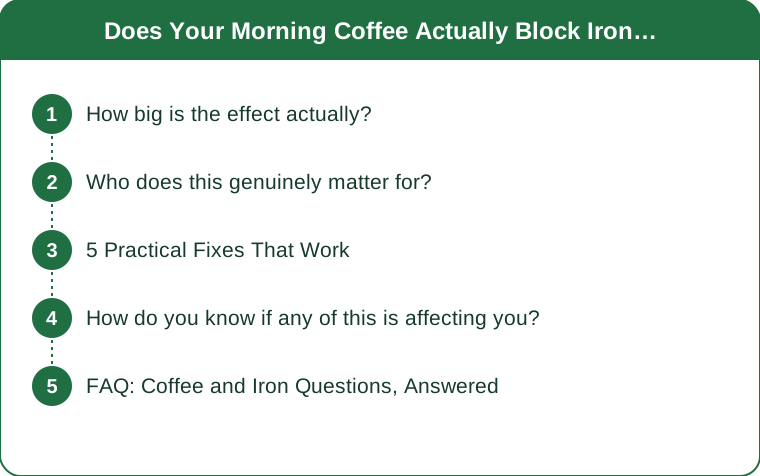
How big is the effect actually?
Substantial for plant iron, modest for animal iron.
Polyphenols are the mechanism. Coffee contains chlorogenic acid; tea contains tannins and catechins. Both bind iron in the digestive tract, forming complexes your gut cannot absorb.
The reductions reported in research are large. Studies on the topic have reported reductions in non-heme iron absorption in the region of 40 to 60 percent with coffee and up to around 80 percent with strong black tea, taken with a meal. The exact numbers vary with beverage strength, volume and the composition of the meal.
Tea is generally the stronger inhibitor than coffee, and black tea more than most others. Herbal teas vary widely — peppermint and chamomile contain polyphenols too, though generally in smaller amounts than black tea.
Heme iron is far less affected. Iron from meat, poultry and fish is absorbed through a different pathway that polyphenols interfere with much less. If your iron comes mainly from meat, the coffee interaction matters considerably less.
Which is why this matters most for vegetarians and vegans, whose iron is entirely non-heme, and for anyone taking iron supplements — where the entire point is maximising absorption of a single dose.
Timing determines almost everything. The interaction requires the polyphenols and the iron to be in the digestive tract together. Consumed an hour or more apart, the effect is greatly reduced.
Who does this genuinely matter for?
It ranges from critically important to entirely irrelevant depending on your situation.
It matters most if you are taking iron supplements. Prescribed iron is usually being taken to correct a deficiency, and halving its absorption meaningfully extends how long correction takes. Supplements should be taken away from coffee, tea, dairy and calcium supplements.
It matters a great deal for plant-based diets. Non-heme iron is already absorbed less efficiently than heme iron, and adding a strong inhibitor to every meal compounds that. This is a genuinely common contributor to low iron in vegetarians who otherwise eat well.
It matters for women with heavy periods. Heavy menstrual bleeding is one of the most common causes of iron deficiency in women, and anyone in that group with a marginal intake has less room for absorption losses.
It matters for endurance athletes. Iron losses through sweat, gut and foot strike are higher in endurance training, and requirements are elevated.
It matters much less if you eat meat regularly and have normal iron levels. Heme iron absorbs well, and if your levels are fine, timing your coffee is a small optimisation rather than a fix.
And it matters not at all between meals. Coffee drunk at 11am, well away from food, has essentially no relevance to iron absorbed at breakfast or lunch.

5 Practical Fixes That Work
1. Leave an hour on either side. The simplest and most effective change. Coffee an hour before or an hour after the iron-rich meal rather than with it. Most people can shift their coffee by an hour without noticing.
2. Add vitamin C to iron-rich meals. Vitamin C substantially enhances non-heme iron absorption and can partly offset inhibitors. Peppers, citrus, strawberries, broccoli, tomatoes — a squeeze of lemon over lentils or peppers alongside a plant-based meal is a genuine, measurable improvement, not folk wisdom.
3. Take supplements away from all inhibitors. Coffee, tea, dairy, calcium supplements and high-fibre foods all reduce absorption. Many people take iron supplements at bedtime or mid-morning specifically to keep them clear of everything. If iron upsets your stomach, taking it with a small amount of food is a reasonable trade — absorption drops but adherence improves, and a tolerated dose beats a skipped one.
4. Pair plant iron with a small amount of meat when you eat both. The presence of meat enhances non-heme iron absorption from the same meal — a well-documented effect. Even a small portion alongside a lentil or bean dish helps.
5. Do not use cast iron cookware as your strategy. It does transfer small amounts of iron, particularly with acidic foods cooked for a long time, but the amounts are inconsistent and far too small to correct a deficiency. Treat it as a minor bonus rather than a plan.
How do you know if any of this is affecting you?
By testing rather than guessing, because the symptoms overlap with a dozen other things.
Symptoms of low iron are non-specific: fatigue disproportionate to activity, breathlessness on effort, poor exercise recovery, cold hands and feet, hair shedding, and reduced heat tolerance. Every one of these has other causes.
Ferritin is the marker that usually matters for training. It reflects iron stores and falls before haemoglobin does, which means someone can have normal haemoglobin and genuinely depleted stores. Athletes with symptoms and low-normal ferritin are a well-recognised group.
Do not self-prescribe iron supplements. Excess iron accumulates and is genuinely harmful, and some people have conditions that cause iron overload. Testing first is the correct order, and iron supplementation should be based on a blood test rather than symptoms.
Rebuilding stores takes months, not weeks. Correcting depleted ferritin commonly takes three to six months of consistent supplementation, which is why abandoning it after a fortnight because you feel no different is so common and so counterproductive.
Seasonal note: with cooler weather arriving, cold intolerance becomes more noticeable, and low iron is one of the more common reasons people find themselves suddenly much colder than everyone around them. If autumn arrives and you are unusually cold and tired, iron is worth checking rather than assuming.
If you have symptoms of iron deficiency, get a blood test rather than supplementing speculatively. This is general information, not medical advice.
FAQ: Coffee and Iron Questions, Answered
How long should I wait after coffee?
An hour on either side of an iron-rich meal or supplement removes most of the interaction. Longer is marginally better but rarely necessary.
Is decaf better?
Somewhat, but not exempt — the inhibitory effect comes from polyphenols rather than caffeine, and decaf still contains them. The effect is generally smaller than with regular coffee.
What about tea?
Black tea is typically a stronger inhibitor than coffee. Green tea also inhibits. Herbal teas vary, generally with less effect, though some contain meaningful polyphenol levels.
Does milk in coffee make it worse?
Calcium also inhibits iron absorption, so a milky coffee combines two inhibitors. It is a further reason to separate it from an iron-focused meal.
Should I stop drinking coffee if I am iron deficient?
Rarely necessary. Timing it away from meals and supplements achieves nearly all of the benefit without giving anything up.
Does orange juice really help?
Yes — vitamin C meaningfully increases non-heme iron absorption from the same meal, and it is one of the more reliable dietary manoeuvres in this area.
Can I get enough iron without meat?
Yes, with attention. Legumes, tofu, fortified cereals, pumpkin seeds and dark leafy greens supply it, and pairing with vitamin C while avoiding tea and coffee at those meals makes a substantial difference.
TL;DR:
- Coffee and tea polyphenols reduce non-heme iron absorption substantially — commonly cited as 40 to 80 percent when taken with a meal.
- Heme iron from meat is far less affected. This matters most for plant-based diets and iron supplements.
- Leave an hour either side of an iron-rich meal. That single change solves most of it.
- Add vitamin C to iron-rich meals — it works in the opposite direction and partly offsets inhibitors.
- Test before supplementing. Excess iron is genuinely harmful, and rebuilding stores takes three to six months.
If autumn arrives and you are unusually cold, tired and breathless on the stairs, get ferritin checked rather than guessing.
Keep Reading
This article is for general informational purposes only and is not medical advice. Always consult a qualified health professional for guidance specific to you.