Does Cooking in Cast Iron Actually Add Iron to Your Food? The Honest Answer
Quick Answer: Yes - measurable iron migrates from cast iron cookware into food, and studies confirm it. The amount swings enormously with conditions: acidic, moist foods simmered long in a newer or lightly seasoned pan can pick up several milligrams per serving (tomato sauce is the famous case), while a quick sear of a dry food in a well-seasoned pan adds a fraction of a milligram. The transferred iron is non-heme and absorbed at modest rates, so cast iron is a genuine helper for iron-stretched women - and never a treatment for diagnosed deficiency, which needs testing and proper management. Think of the skillet as a background contributor you tune with acid, moisture, and simmer time.
Somewhere between folk wisdom and chemistry class lives the claim that grandma’s skillet was her iron supplement. It turns out the chemists checked - repeatedly, in labs and in villages - and grandma comes out looking pretty good, with footnotes worth reading before you rehome your other pans.

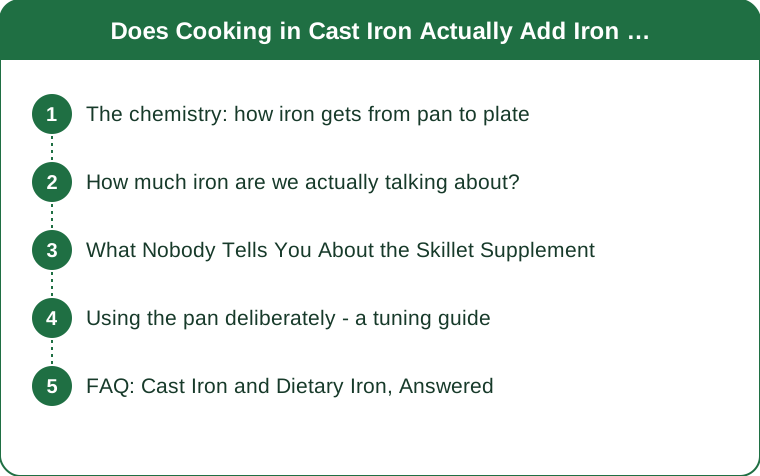
The chemistry: how iron gets from pan to plate
The surface of the pan is the ingredient. Cast iron is essentially pure elemental iron with carbon; wherever food contacts bare or thinly seasoned metal, acids and moisture dissolve trace iron ions into the dish. This is ordinary chemistry - the same reaction that flash-rusts a wet unseasoned skillet overnight - happening gently, in food, at cooking temperatures.
Acid is the crowbar. Low pH dramatically accelerates the dissolution: tomato sauces, chili, wine braises, citrus-finished dishes, and vinegar-touched anything pull iron at multiples of the rate of neutral foods. The classic laboratory numbers: spaghetti sauce simmered in cast iron measured several-fold iron increases versus glass cookware, with long-simmered acidic dishes among the biggest gainers.
Moisture and time do the hauling. Wet foods in prolonged contact - soups, sauces, stews - accumulate far more than dry, quick-contact foods. A three-hour chili is a mining operation; a ninety-second pancake is a handshake.
Seasoning is a partial roadblock, on purpose. The polymerized oil layer that makes cast iron release eggs also insulates food from metal. A glassy, well-built seasoning cuts transfer substantially - which is why the biggest iron numbers in studies come from newer or lightly seasoned pans, and why your grandmother’s actual pan, seasoned by decades, was transferring less than the legend suggests. The pan gives you either nonstick performance or maximum iron per dish - you tune the dial, dish by dish.
And the transferred iron is the non-heme kind. It enters the same absorption pathway as plant iron: typically single-digit to low-teens percent absorbed, boosted meaningfully by vitamin C in the same meal, and suppressed by coffee and tea nearby. The pan adds real milligrams; your meal composition decides how many of them clear customs.
How much iron are we actually talking about?
Numbers, with their honest error bars.
The famous measurements: in the classic cookware analyses, applesauce and spaghetti sauce cooked in cast iron jumped from well under a milligram to several milligrams of iron per serving - increases of two to seven milligrams in the acidic, long-cooked dishes. Scrambled eggs and other quick, low-acid foods gained fractions of a milligram. Later studies, including trials giving cast iron pots to households in low-resource settings, found improved iron status in some (especially children) and small effects in others - with pan condition, cuisine acidity, and cooking style explaining the spread.
Context for those milligrams: premenopausal women need roughly 18 mg of dietary iron daily - a target many run well short of. Against that, a cast-iron-simmered tomato sauce contributing even two or three extra milligrams (of which a fraction absorbs) is a genuinely useful nudge - comparable to adding a serving of legumes - not a rounding error, and not a supplement either.
The variables that swing your personal number: pan age and seasoning thickness (new and lightly seasoned transfers most), dish acidity, moisture, contact time, and even stirring (scraping the surface refreshes contact). A worn spot in old seasoning quietly becomes the pan’s most generous zone.
Enameled cast iron transfers essentially nothing - the glass coating is a complete barrier, which is exactly why it is the recommendation for the small group who must limit iron. Carbon steel behaves like a milder cast iron; stainless contributes trivial amounts plus traces of nickel and chromium.
Bottom line arithmetic: a household that runs its acidic simmers through bare cast iron a few times weekly adds a modest, real stream of non-heme iron to the diet - meaningful across months for the marginal, invisible for the replete, and never a substitute for diagnosis when symptoms suggest actual deficiency.

What Nobody Tells You About the Skillet Supplement
The metallic-tasting tomato sauce is the dose announcing itself. Long acidic simmers in bare cast iron can pick up enough iron to taste faintly tinny and darken slightly - harmless, and informative: flavor change means you found the high-transfer configuration. Cooks who love their cast iron but not the taste route the marinara through enamel and keep the skillet for everything else - which is also, quietly, the iron-management dial.
The seasoning paradox is the part everyone gets backwards. The better you maintain your pan - the glossier the seasoning - the less iron it donates. The pans transferring the most are the neglected, the new, and the freshly stripped-and-recovering. If your cast iron routine is impeccable, count your pan as a minor contributor, not a major one.
Iron fish and iron ingots are the purpose-built version. Where the pan is not practical, cast iron lumps designed to be dropped into simmering pots - popularized in Cambodia’s lucky iron fish programs - deliver a controlled dose per use with decent trial evidence behind them. Same chemistry, dial pre-set - and a reasonable tool for plant-based households that pressure-cook in stainless.
Vitamin C in the same pot multiplies the harvest. Tomatoes achieve this automatically - their acid mines the iron and their vitamin C escorts it through absorption, making cast iron marinara the accidental perfect delivery system. Adding peppers to the chili or finishing lentils with lemon runs the same play deliberately. Coffee or tea right after the meal runs the opposite one.
Some people should NOT chase this. Hereditary hemochromatosis - genetic iron overload, more common than most people guess - and other iron-loading conditions make minimizing absorbable iron the goal; that is the population for whom enameled cookware is standard advice. Men and postmenopausal women, who lose little iron, rarely benefit from maximizing transfer either. Iron is a both-directions mineral: the skillet trick is for the iron-stretched, not for everyone.
And no, the pan cannot treat anemia. Symptoms like exhaustion, hair shedding, ice cravings, and breathlessness deserve a ferritin test and a clinician, not a cookware upgrade - the pan is prevention-scale, and deficiency is treatment-scale.
Using the pan deliberately - a tuning guide
To harvest more iron: run acidic, moist, long-cooked dishes in bare (non-enameled) cast iron - tomato sauces, chili, curries with tomato bases, bean stews, shakshuka; stir and scrape honestly; include a vitamin C source in the dish or meal; keep coffee and tea an hour away from those meals; and do not over-baby the seasoning on the pot you use for simmering (a functional but unglamorous seasoning is the sweet spot: still cooks well, still donates).
To harvest less (overload conditions, or you simply dislike the taste): enameled cast iron or stainless for everything acidic and long, bare cast iron reserved for quick, dry, fatty jobs - searing, roasting, frying - where transfer is minimal and the pan’s strengths are maximal.
The household default that suits most iron-stretched women: two-pan doctrine. One bare cast iron skillet for daily searing and the weekly acidic simmer; one enameled or stainless pot for delicate and taste-sensitive dishes. This delivers a steady low-dose iron stream without sacrificing any dinner to tinny marinara.
Care routine that preserves both jobs: dry immediately after washing (the same reactivity that feeds you also rusts the pan), thin oil wipe after drying, and periodic stovetop re-seasoning. A rusty pan is not dangerous so much as badly managed - scrub the rust fully and re-season; food-contact rust in trace amounts is not a health event, just a flavor and maintenance one.
Pair the pan with the rest of the iron toolkit: the skillet is one instrument in the orchestra - legumes, dark leafy greens, red meat or mussels if you eat them, pumpkin seeds, vitamin C pairing, and tea-timing discipline. For menstruating women, endurance runners, and plant-based eaters (the classic overlap), the orchestra plus an annual ferritin check is the actual strategy; the pan is the free instrument that plays while you cook.
This is general information, not medical advice - fatigue and suspected deficiency warrant testing, and anyone with an iron-overload condition should follow their clinician’s cookware and diet guidance.
FAQ: Cast Iron and Dietary Iron, Answered
How much iron does cast iron cooking really add?
It ranges from a fraction of a milligram (quick, dry foods in a well-seasoned pan) to several milligrams per serving (acidic sauces simmered long in newer or lightly seasoned pans) - laboratory analyses of tomato sauce found multi-fold increases versus other cookware. Acidity, moisture, contact time, and seasoning thickness are the four dials.
Is iron from a cast iron pan actually absorbed?
Yes, at non-heme rates - typically single digits to low teens percent, the same pathway as plant iron. Vitamin C in the meal raises absorption meaningfully; coffee and tea near the meal suppress it. The tomato dishes that leach the most iron conveniently carry their own vitamin C, which is why they are the star example.
Does enameled cast iron give you any iron?
Essentially none - the enamel is a glass barrier between food and metal. That makes enameled pieces the right tool for people with iron-overload conditions, for taste-sensitive acidic dishes, and for anyone who wants cast iron’s heat behavior without the chemistry.
Can cooking in cast iron replace iron supplements?
No. The pan contributes prevention-scale amounts - a useful background stream for people with adequate-but-tight intake. Diagnosed deficiency involves needs an order of magnitude beyond what cookware provides and deserves testing, cause-finding, and clinician-managed repletion. Skillet alongside treatment, fine; skillet instead of treatment, no.
Does a well-seasoned pan still transfer iron?
Some, but substantially less - the polymerized seasoning layer insulates food from metal, and the biggest transfer numbers come from new, stripped, or thin-seasoned surfaces. If you want both nonstick performance and iron contribution, keep the seasoning functional rather than museum-grade on your simmer pot, or simply accept the lower dose as the price of perfect eggs.
TL;DR:
- The folk claim is confirmed chemistry: acid, moisture, time, and thin seasoning move real milligrams of iron from pan to food - tomato sauce is the champion case.
- Transfer ranges from trivial (quick dry sear, glossy seasoning) to several milligrams per serving (long acidic simmer, newer pan); enameled transfers none.
- It is non-heme iron: vitamin C in the meal multiplies absorption, coffee and tea nearby suppress it.
- Useful as a background stream for iron-stretched women; irrelevant for the replete; contraindicated for iron-overload conditions; never a treatment for diagnosed deficiency.
- Run the two-pan doctrine - bare skillet for sears and the weekly acidic simmer, enamel for taste-sensitive dishes - and get ferritin checked if symptoms suggest more than a cookware question.
Grandma’s skillet really was topping up the family’s iron - a few milligrams at a time, tomato sauce by tomato sauce. Keep the pan in the rotation; just let the lab, not the legend, handle anything that feels like actual deficiency.
Keep Reading
This article is for general informational purposes only and is not medical advice. Always consult a qualified health professional for guidance specific to you.