Does Tea With Dinner Affect Iron More Than Coffee With Breakfast?
Quick Answer: Tea with dinner usually costs you more iron than coffee with breakfast - not because tea is worse per cup, but because dinner is typically the meal carrying the most iron. Black tea can reduce non-heme iron absorption by roughly 60 to 70%, coffee by around 40 to 60%, and both act only on the meal they are consumed with. Separating tea and coffee from your iron-rich meal by 1 to 2 hours removes almost the entire effect.
The timing matters far more than the beverage, which is good news if you like both.

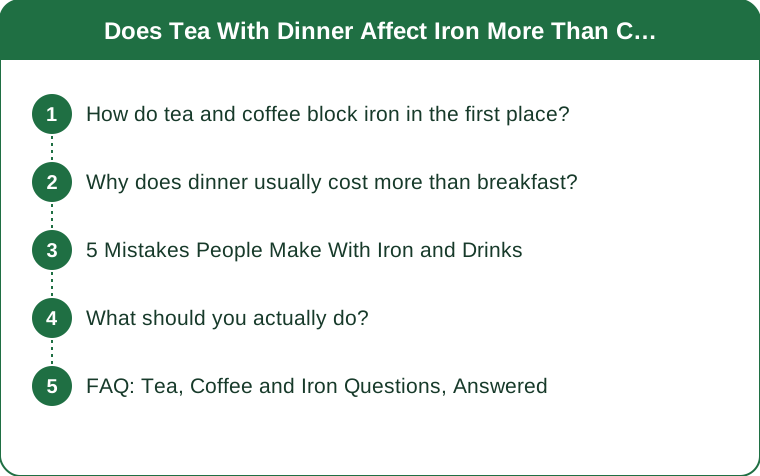
How do tea and coffee block iron in the first place?
Through polyphenols that bind iron in the gut before it can be absorbed.
Tea contains tannins, a class of polyphenol that forms insoluble complexes with iron in the digestive tract. Once bound, the iron passes through without being absorbed.
Coffee contains chlorogenic acid, which works by a similar mechanism with somewhat lower potency per cup.
Both act only on non-heme iron - the form found in plants, fortified foods, and supplements. Heme iron from meat, poultry, and fish is largely unaffected, which is the single most useful fact in this entire topic.
The effect is dose-dependent and immediate. A strong, long-steeped tea inhibits more than a weak one. Steeping time matters more than most people expect - a five-minute brew extracts substantially more tannin than a two-minute one.
And it is meal-specific, not systemic. Neither drink depletes your iron stores or damages absorption capacity. They interfere with the iron present in the stomach at that moment, and that is the whole mechanism. Nothing carries over to the next meal.
Why does dinner usually cost more than breakfast?
Because of what is actually on each plate.
A typical breakfast is not iron-dense. Toast, yoghurt, eggs, fruit - eggs contain iron but in a poorly absorbed form, and the totals are generally modest. Blocking 50% of a small amount is a small loss.
Dinner is usually where the iron is. Lentils, beans, tofu, spinach, fortified grains, red meat, dark poultry - the evening meal carries the majority of daily iron intake for most people. Blocking 60% of a large amount is a large loss.
Fortified breakfast cereal is the exception that reverses the picture. If your breakfast is a fortified cereal, that meal may be your single largest non-heme iron source of the day, and coffee alongside it is genuinely costly. This is the most common hidden case.
A rough worked example. A lentil dinner might contain around 6mg of iron; strong tea with it could reduce absorption by roughly two-thirds. A toast-and-yoghurt breakfast might contain 2mg; coffee could halve it. The dinner loss is several times larger in absolute terms, which is exactly why the timing advice is usually pointed at the evening.
The practical conclusion: look at your own two meals honestly and apply the separation rule to whichever one carries more iron. For most people that is dinner, but for cereal eaters it is breakfast.

5 Mistakes People Make With Iron and Drinks
1. Giving up tea and coffee entirely. Completely unnecessary. Separating them from iron-rich meals by 1 to 2 hours captures nearly all the benefit, and both drinks have documented health benefits of their own.
2. Assuming herbal teas are safe. Many are not. Peppermint, chamomile, and vervain infusions have measurable iron-inhibiting effects in published work, and some are comparable to black tea. Rooibos is generally lower.
3. Taking an iron supplement with breakfast tea or coffee. This is the single most costly version, because supplemental iron is non-heme and highly susceptible. Iron supplements are best taken away from meals, with vitamin C, and well away from tea, coffee, dairy, and calcium supplements.
4. Ignoring vitamin C, which is the bigger lever. Vitamin C forms a soluble complex with non-heme iron and can increase absorption two- to threefold. Adding a source of vitamin C - peppers, tomatoes, citrus, broccoli - to an iron-rich meal often more than offsets a moderate tannin effect. Adding is easier than removing.
5. Forgetting the meat effect. Even a small amount of meat, poultry, or fish in a meal improves absorption of the non-heme iron alongside it, through a mechanism that is still not fully explained. A little fish in a lentil dish helps the lentils, which is a genuinely useful piece of kitchen knowledge.
What should you actually do?
Four rules, in order of impact.
1. Move the drink, not the meal. Coffee and tea 1 to 2 hours before or after your main iron-containing meal. In practice: coffee mid-morning rather than with cereal, tea an hour after dinner rather than alongside it.
2. Add vitamin C to the iron meal. A squeeze of lemon on the lentils, peppers in the stir-fry, tomatoes with the beans, or a piece of fruit afterwards. This is the highest-value habit in the entire topic because it works by addition rather than restriction.
3. Brew shorter if you must drink with a meal. A two-minute steep contains meaningfully less tannin than a five-minute one, and adding milk reduces the effect slightly through protein binding.
4. Take supplements properly if you take them. Away from food where tolerated, with vitamin C, and never with tea, coffee, or calcium. Alternate-day dosing is increasingly supported for improving absorption, which is worth discussing with your doctor.
Who needs to care most: menstruating women, vegetarians and vegans, endurance athletes, blood donors, pregnant women, and anyone with diagnosed low ferritin. Everyone else can apply the timing rule loosely and not think about it much.
And as autumn arrives, warm drinks with meals become far more frequent - the afternoon tea that was iced in July is hot and steeped long in October. This is a seasonal drift worth noticing, because it happens gradually enough that nobody connects it to anything.
FAQ: Tea, Coffee and Iron Questions, Answered
How long should I wait between tea and an iron-rich meal?
One to two hours in either direction removes most of the effect. One hour is enough for practical purposes for most people.
Does green tea block iron more than black tea?
Both inhibit absorption. Black tea generally has higher tannin content, but steeping time and strength influence the result more than the variety does.
Does milk in tea help?
Slightly - milk proteins bind some tannins. However, calcium itself inhibits iron absorption, so milky tea is not a clean solution. Timing remains the better answer.
Do I need to worry if I eat meat regularly?
Much less. Heme iron from meat, poultry, and fish is largely unaffected by tannins, so regular meat eaters with normal iron status can be relaxed about this.
Should I stop drinking coffee to improve my iron levels?
No. Shift the timing and add vitamin C to iron-rich meals - that combination is far more effective than eliminating coffee, and considerably more sustainable.
This is general nutrition information, not medical advice. Suspected iron deficiency should be confirmed with blood work and managed with a doctor, since iron supplementation without a documented need carries its own risks.
TL;DR:
- Tea with dinner usually costs more than coffee with breakfast, because dinner is where most people’s iron is - unless you eat fortified cereal, in which case breakfast is the expensive meal.
- Black tea can reduce non-heme iron absorption by 60 to 70%, coffee by 40 to 60% - and heme iron from meat, poultry, and fish is largely unaffected.
- Separating drinks from the iron meal by 1 to 2 hours removes almost the whole effect - no need to give anything up.
- Adding vitamin C is the bigger lever than removing tannins, and a little meat improves absorption of the plant iron beside it.
The reason this is worth ten seconds of attention is how cheap the fix is. Moving one cup of tea an hour later costs you nothing and recovers most of the iron from your largest meal - and for anyone with borderline ferritin, that is a genuinely meaningful difference over a year.
Keep Reading
This article is for general informational purposes only and is not medical advice. Always consult a qualified health professional for guidance specific to you.