Tired All the Time? The Food-First Checklist Before You Blame Everything Else
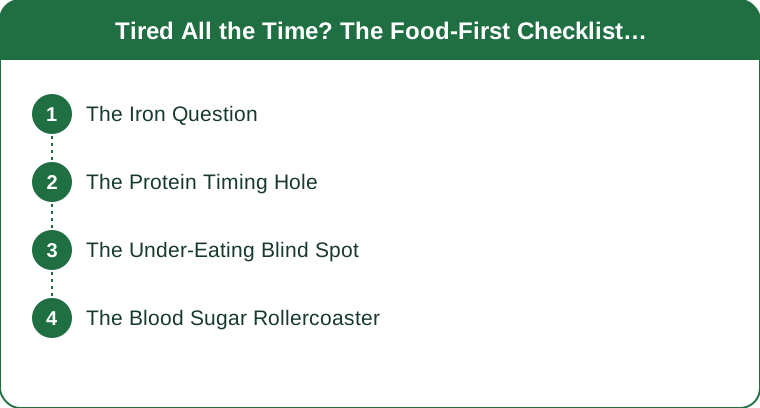
Quick Answer: Persistent fatigue has a short nutritional suspect list: low iron, low B12, protein loaded entirely into dinner, chronic under-eating, and blood sugar swings. Get bloodwork first — ferritin, B12, and thyroid — then run this checklist alongside it. Never supplement iron without a test.
Tiredness gets blamed on everything. Age. Stress. Screens. Mercury.
Meanwhile the plate is quietly under-delivering, and it’s been doing it for eight months.
The important caveat up front: test, don’t guess. Ferritin, B12, and thyroid bloodwork will answer in a week what a food checklist can only hint at. This runs alongside that — not instead of it.

Could low iron be causing my fatigue?
It’s the headline suspect, especially for menstruating women, and it’s the one most often missed.
The pattern to recognize: tiredness that sleep doesn’t fix. Not “I need an early night” tired — tired after nine hours. Often with breathlessness on stairs that used to be easy, cold hands and feet, unusual hair shedding, or an odd craving for ice.
Here’s the part that gets missed: you can be iron-deficient with a normal hemoglobin. Ferritin — your stored iron — drops well before red blood cell counts do, and symptoms can appear in that window. If you’re getting tested, ask specifically for ferritin, not just a standard blood count.
Then the food audit, honestly: how often does an iron-rich food actually appear on your plate? Red meat, liver, lentils, chickpeas, tofu, pumpkin seeds, fortified cereals, dark leafy greens. Lentils twice a month is a rounding error, not a strategy.
Two things that change absorption meaningfully:
- Vitamin C with the meal substantially improves absorption of plant-based (non-heme) iron. Lemon on the lentils, peppers in the stir-fry.
- Tea and coffee with meals inhibit it. Move them 60 minutes either side.
Do not start an iron supplement without a test. Excess iron is genuinely harmful and the body has no easy way to excrete it. This one isn’t a “can’t hurt to try” situation.
Why do I crash in the afternoon?
Because of when your protein arrives, not how much of it you eat.
The extremely common pattern: coffee for breakfast, a small salad at lunch, and then 40 grams of protein at dinner. The daily total might be fine. But the first ten hours of the day ran on almost nothing, and the crash timing tracks the gap precisely.
Protein does two useful things here: it slows carbohydrate absorption (flattening the glucose curve) and it drives satiety, which stops the 3 p.m. vending machine decision from happening at all.
The fix is redistribution, not addition. Aim for roughly 25–30g of protein at breakfast and again at lunch, and let dinner be smaller than it currently is. Same daily total, completely different afternoon.
What that looks like in practice: three eggs, or a cup of Greek yogurt with nuts, or a protein shake at breakfast. Then chicken, tuna, tofu, or beans actually in the lunch salad rather than beside it as a garnish.
Redistribution alone resolves a surprising share of afternoon fatigue, and it costs nothing.

Am I just not eating enough?
This is the blind spot, because chronic mild under-eating doesn’t feel like deprivation. It feels like being busy and disciplined.
The shape of it: breakfast skipped because the morning got away from you, lunch eaten standing up in nine minutes, a perpetual low-grade diet running in the background for three years. No single day looks like a problem. The cumulative deficit absolutely is.
Energy requires energy. When intake runs consistently below need, the body doesn’t distribute the shortfall evenly — it down-regulates whatever it considers optional first. That list tends to include reproductive hormones, thyroid output, body temperature, hair and nail growth, immune response, and non-essential movement.
The tells, beyond tiredness: feeling cold constantly, hair thinning, cycle changes or a missing period, getting sick more often, poor recovery from workouts, low mood, and a noticeable drop in the small fidgety movements you used to make without thinking.
A missing or irregular period is a red flag that warrants a doctor’s visit, not a dietary tweak. So is unintentional weight loss.
If you’re training regularly and eating “clean but small,” this is worth taking seriously. Under-fueling reads as virtue and performs as exhaustion.
Is my blood sugar behind the mysterious tiredness?
Check the timing. Glucose-driven fatigue keeps office hours.
If your crash lands at 10:30 and again at 2:47 — suspiciously precise, roughly 90 minutes to two hours after eating — that’s the spike-and-crash pattern, not a mystery. A refined-carb meal eaten alone produces a fast rise and an equally fast drop, and the drop is what you feel.
The fix set, all of which are small:
- Pair every carb with protein or fat. Toast with eggs, not toast alone. Apple with almond butter, not apple alone.
- Anchor with protein at every meal, per the redistribution point above.
- Walk 10–15 minutes after eating. Muscle contraction pulls glucose out of the bloodstream without needing insulin. A post-lunch walk is one of the highest-return habits available for afternoon energy, and it takes almost no time.
- Put fiber first. Vegetables or salad before the starch in a meal noticeably blunts the glucose rise.
If the tiredness follows a clock, it’s probably food timing. If it’s constant regardless of when you eat, look back at iron and under-eating.
5 Mistakes Everyone Makes With Fatigue
- Supplementing iron without testing. Common, and genuinely risky. Get ferritin checked first.
- Adding more coffee. It borrows energy from later in the day and disrupts the sleep that would have fixed it.
- Eating “clean but small.” The most-praised version of under-fueling.
- Only testing hemoglobin. Ferritin drops first — ask for it by name.
- Accepting it as a personality trait. The one that costs the most time. “I’m just a tired person” is a conclusion people reach after years, usually without ever having run a basic blood panel.
FAQ
What blood tests should I ask for if I’m always tired?
A reasonable starting panel: full blood count, ferritin, B12, folate, vitamin D, TSH (thyroid), and HbA1c or fasting glucose. Ask for ferritin explicitly — it’s frequently left off, and it’s the one most likely to explain fatigue in menstruating women.
How long does it take to feel better after fixing low iron?
If iron deficiency is the cause, most people notice improvement within 3–6 weeks of appropriate treatment, with fuller resolution over about three months as stores rebuild. If you’ve been supplementing correctly for six weeks with no change, go back to your doctor — the fatigue likely has another cause.
Can vegetarians get enough iron from food?
Yes, with attention. Plant iron is absorbed less efficiently, so the practical approach is more frequent sources — lentils, chickpeas, tofu, pumpkin seeds, fortified grains — always paired with vitamin C, and with tea and coffee moved away from meals. Vegetarians and vegans should also monitor B12, which is not reliably available from plants without fortification or supplementation.
When should I see a doctor about fatigue?
Sooner than most people do. Book an appointment if fatigue has lasted more than a few weeks, doesn’t improve with sleep, or comes with any of: breathlessness, chest pain, unintentional weight loss, a missing period, persistent low mood, swollen glands, or fever. Fatigue is also a symptom of thyroid disease, sleep apnea, depression, diabetes, and a long list of other conditions that food cannot fix. This checklist is a starting point, not a diagnosis.
TL;DR:
- Test first — ferritin, B12, thyroid. Never supplement iron blind
- Iron: sleep-proof tiredness, breathlessness on stairs; pair with vitamin C, keep tea and coffee 60 min away from meals
- Redistribute protein: 25–30g at breakfast and lunch, not all at dinner
- Chronic under-eating reads as discipline and performs as exhaustion — watch for cold hands, hair loss, cycle changes
- Crashes with precise timing (10:30, 2:47) are blood sugar: pair carbs, eat fiber first, walk 10–15 min after meals
- See a doctor if fatigue lasts weeks or comes with any red-flag symptom
Persistent fatigue has a short suspect list. Audit it before accepting tiredness as a personality trait.
Keep Reading
This article is for general informational purposes only and is not medical advice. Always consult a qualified health professional for guidance specific to you.