Ferritin vs Hemoglobin: Which Number Actually Matters for Training?
Quick Answer: Hemoglobin measures the oxygen-carrying protein currently in your blood. Ferritin measures stored iron. Stores deplete first, so ferritin falls months before hemoglobin does — meaning you can be genuinely iron deficient, feel it in training, and have a completely normal hemoglobin result. If you are being tested for fatigue and only hemoglobin was checked, the test may have missed it.
Ask for ferritin. It is the number that moves first and the one that correlates with how training feels.

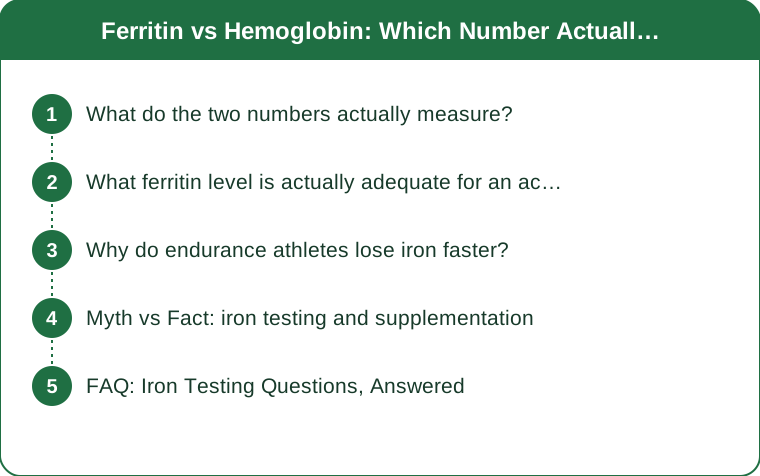
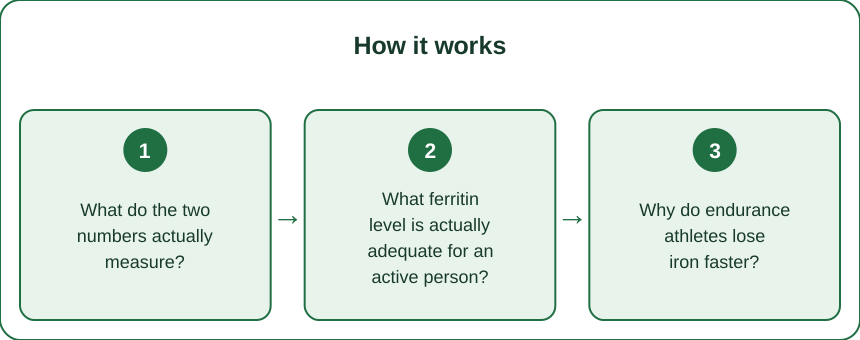
What do the two numbers actually measure?
Two different points in the same system, and the order they fall in is the whole story.
Hemoglobin is the iron-containing protein inside red blood cells that carries oxygen. A hemoglobin result tells you how much oxygen-carrying capacity is circulating right now. Low hemoglobin is the definition of anemia.
Ferritin is the protein that stores iron in tissues, primarily the liver, spleen and bone marrow. Serum ferritin correlates with total body iron stores, and it is the standard marker for assessing them.
The sequence of depletion has three stages:
Stage 1: Iron depletion. Stores fall. Ferritin drops. Hemoglobin is normal. You may feel fatigued, particularly during training, and standard bloodwork that only checks hemoglobin looks completely fine.
Stage 2: Iron-deficient erythropoiesis. Stores are exhausted and red cell production begins to be limited. Ferritin is low, transferrin saturation falls, and hemoglobin is still often within the normal range or at its lower edge.
Stage 3: Iron deficiency anemia. Hemoglobin finally falls below the reference range. This is where a hemoglobin-only test finally catches it, and it is the last stage rather than the first.
The practical consequence: by the time hemoglobin is abnormal, you have been iron deficient for a considerable period. For anyone training seriously, that is a long time spent training with impaired capacity.
What ferritin level is actually adequate for an active person?
Higher than the bottom of the reference range, and this is where a lot of confusion originates.
Typical laboratory reference ranges for ferritin in women often start around 10 to 15 ng/mL. A result of 14 will frequently be reported as normal.
The problem with that: reference ranges are derived from population distributions, not from what supports optimal function. A substantial body of literature on athletes and on fatigue suggests that symptoms and impaired performance can occur at ferritin levels well within the normal range.
Levels commonly discussed in sports medicine:
- Below 15 ng/mL: iron deficiency by most definitions
- 15 to 30 ng/mL: frequently associated with symptoms in athletes, and many sports physicians treat in this range
- 30 to 50 ng/mL: an often-cited target minimum for endurance athletes
- Above 50 ng/mL: generally considered adequate for training
Important caveat: these thresholds are debated, they vary between clinicians and guidelines, and interpretation depends on the individual. This is not a self-diagnosis framework — it is context for a conversation with a clinician who can see the whole picture. This is general information, not medical advice.
The confounder you need to know about: ferritin is an acute phase reactant, meaning it rises with inflammation, infection and hard training. A ferritin measured shortly after a hard session or during an infection can look falsely reassuring. Test when rested and not unwell, and ideally alongside a marker of inflammation like CRP so the result can be interpreted properly.

Why do endurance athletes lose iron faster?
Four mechanisms, and they stack.
Foot-strike hemolysis. Repeated impact destroys a small number of red blood cells in the feet with each step. Over the volume a distance runner accumulates, this contributes measurably to iron loss.
Hepcidin elevation after exercise. This is the mechanism that surprises people. Hard training raises inflammatory signaling, which raises the hormone hepcidin, and hepcidin blocks iron absorption in the gut. The elevation peaks roughly three to six hours after a hard session — meaning an iron supplement taken in the evening after a hard morning workout is being absorbed during the worst possible window.
Sweat and gastrointestinal losses. Both are small individually and add up over high training volumes.
Menstrual losses. For menstruating women this is typically the largest single factor, and heavy periods are one of the most common causes of iron deficiency generally. This is the most important thing to discuss with a clinician if you are training hard and running low.
What follows from the hepcidin mechanism: take iron in the morning, on an empty or near-empty stomach, and ideally before rather than after hard training. Not in the evening after a hard session, which is exactly when most people take it.
And the absorption details that matter:
- Vitamin C substantially improves non-heme iron absorption. Take iron with orange juice or a vitamin C supplement.
- Coffee, tea, calcium and dairy all inhibit it. Separate iron from all of them by at least an hour.
- Alternate-day dosing may absorb better than daily dosing, because a dose itself raises hepcidin for the following day. Several studies support this, and it also reduces the gastrointestinal side effects that cause most people to abandon supplementation.
Myth vs Fact: iron testing and supplementation
Myth: If my hemoglobin is normal, my iron is fine.
Fact: Hemoglobin is the last thing to fall. Normal hemoglobin with low ferritin is a well-recognized state, and it is where a lot of unexplained training fatigue in women sits.
Myth: Everyone who is tired should take iron.
Fact: No. Iron overload is genuinely harmful, hemochromatosis is more common than people assume, and unnecessary supplementation causes gastrointestinal problems for no benefit. Test before supplementing, always.
Myth: Eating spinach and cooking in cast iron will fix a deficiency.
Fact: Non-heme iron from plants is poorly absorbed, and while cast iron cooking does transfer a small amount, neither approach reliably corrects an established deficiency. Diet supports iron status and rarely repairs a significant deficit on its own.
Myth: You will feel better within days of starting iron.
Fact: Repleting stores takes months. Hemoglobin, if it was low, typically improves within weeks, but ferritin recovery to a comfortable level commonly takes three to six months of consistent supplementation. Stopping when you feel better usually means the stores never refilled.
Myth: Iron supplements always cause constipation.
Fact: Common, but formulation and dosing schedule both matter. Alternate-day dosing, lower doses, and different iron salts all reduce side effects substantially. If one form was intolerable, that does not mean all of them will be — that is a conversation with your clinician or pharmacist rather than a reason to give up.
FAQ: Iron Testing Questions, Answered
What should I ask for when getting tested?
A full iron panel rather than a single number: ferritin, serum iron, transferrin or TIBC, transferrin saturation, plus a full blood count. Adding CRP helps interpret ferritin correctly, since inflammation inflates it.
When in my cycle should I test?
Avoid testing during or immediately after your period if you can, since acute blood loss shifts the numbers. Mid-cycle is generally a cleaner picture, and consistency between tests matters more than the exact day.
How long after a hard workout should I wait to test?
At least 24 to 48 hours, and longer if the session was very hard or unusually long. Ferritin rises with the inflammatory response and can read misleadingly high.
Can I be iron deficient if I eat a lot of red meat?
Yes, particularly with heavy menstrual bleeding, high training volume, or a gut condition affecting absorption such as celiac disease. Intake is only one side of the equation.
How often should I retest if I am supplementing?
Commonly around three months in, then periodically depending on the result and your clinician’s guidance. Retesting matters both to confirm improvement and to avoid overshooting.
TL;DR:
- Ferritin measures stored iron and falls first; hemoglobin measures circulating capacity and falls last.
- Normal hemoglobin with low ferritin is a real, symptomatic state — ask for ferritin specifically.
- Reference ranges start low; many sports clinicians target above 30 to 50 ng/mL for endurance athletes.
- Hepcidin rises three to six hours after hard training, so take iron in the morning, not after evening sessions.
- Vitamin C helps absorption; coffee, tea and dairy block it. Alternate-day dosing often absorbs better.
- Never supplement without testing — iron overload is genuinely harmful.
If you are training hard and tired, and someone told you your bloods were normal, find out whether ferritin was actually measured.
Keep Reading
This article is for general informational purposes only and is not medical advice. Always consult a qualified health professional for guidance specific to you.