Your Iron Test Came Back Normal and You Are Still Exhausted
Quick Answer: Standard lab reference ranges for ferritin often start as low as 10 to 15 ng/mL, which is derived from the statistical distribution of a general population rather than from the level at which people feel and perform well. A substantial body of research on active women suggests symptoms and endurance performance are affected below roughly 30 ng/mL, and some sports medicine guidance uses 40 ng/mL or higher as a working target. So a ferritin of 18 is genuinely normal by the lab’s definition and genuinely low for an active woman. Ask for ferritin specifically, not just hemoglobin.
You went in tired. They ran bloods. Everything came back normal, and you left with no explanation and the same fatigue.
The word normal is doing an unusual amount of work in that sentence, and understanding what it actually means is often what unlocks the conversation.

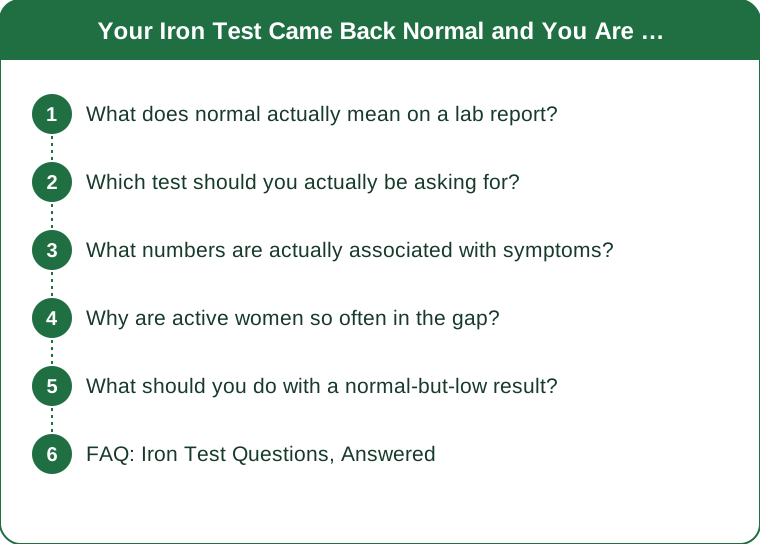
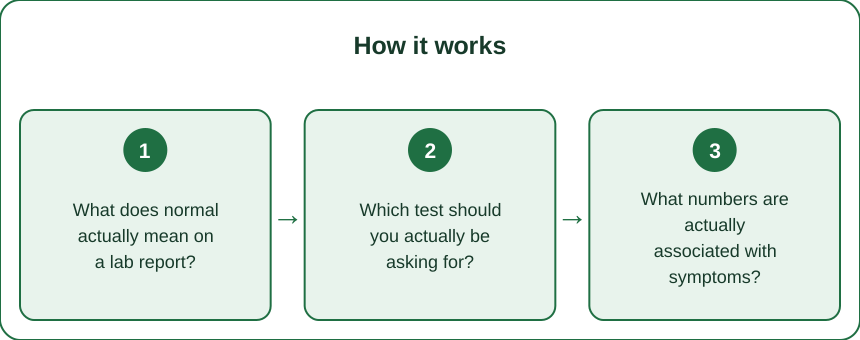
What does normal actually mean on a lab report?
It means you fall inside a statistically derived reference interval, and that interval was not built around how you feel.
Reference ranges are typically constructed by measuring a reference population, usually people considered healthy, and defining the range as the central 95 percent of the results. The bottom 2.5 percent and the top 2.5 percent fall outside.
Two consequences follow, and neither is intuitive.
First, the range describes the population, not optimal function. If a meaningful share of the reference population has suboptimal iron stores, and in menstruating women that is likely, then the bottom of the range reflects that.
Second, the range is not the same everywhere. Ferritin reference ranges vary substantially between laboratories, with lower bounds anywhere from about 10 to 30 ng/mL. The same result can be flagged low at one lab and normal at another.
The practical translation: normal means not obviously pathological. It does not mean adequate for training, or adequate for how you want to feel.
Which test should you actually be asking for?
Ferritin, and it is frequently not included in a standard panel.
Hemoglobin measures the oxygen-carrying protein currently in your blood. It is the last thing to fall. By the time hemoglobin drops, iron stores have already been depleted for a long time. A normal hemoglobin rules out anemia and says very little about iron sufficiency.
Ferritin measures stored iron. It falls first, often long before hemoglobin moves. This is the test that catches the state most active women are actually in: iron depletion without anemia.
Transferrin saturation shows how much of your iron transport capacity is in use, and it adds useful context, particularly when ferritin readings are ambiguous.
The important caveat about ferritin: it is an acute phase reactant, meaning it rises with inflammation, infection, and intense exercise regardless of iron status. So a ferritin drawn during illness, or within a few days of a hard session, can look falsely reassuring.
How to get a clean reading:
- Draw it in the morning, fasted
- At least 3 days after a hard training session or a race
- Not during an illness or shortly after one
- Ideally ask for CRP alongside it, which flags whether inflammation is elevating the number
Ask explicitly. Ferritin is often omitted from standard fatigue workups, and requesting it by name is usually all it takes.
What numbers are actually associated with symptoms?
The literature is not perfectly unified, and the picture is consistent enough to be useful.
Below 15 ng/mL: iron deficiency by nearly any definition. Almost always flagged and treated.
15 to 30 ng/mL: typically reported as normal. A substantial body of research on non-anemic iron deficiency in active women finds fatigue and reduced endurance performance in this band, and several supplementation trials in this range have shown improvements in fatigue and in measures of aerobic capacity.
30 to 50 ng/mL: generally comfortable for most people. A number of sports medicine practitioners use 40 ng/mL as a working floor for endurance athletes, though this is practice-based rather than firmly established by trials.
Above 50 ng/mL: iron is unlikely to be the explanation for your fatigue, and it is worth looking elsewhere rather than supplementing.
Two things to hold alongside these numbers.
Individual variation is genuine. Some people function well at 20. Others feel noticeably better at 45. The numbers are a guide to where the conversation should go, not a diagnosis.
More is not better. Iron overload is a real condition with real consequences, and unnecessary supplementation is not harmless. Ferritin above the top of the range warrants investigation in its own right, not celebration.

Why are active women so often in the gap?
Several drains stack, and most of them are invisible in a standard history.
Menstrual loss is the largest single factor. Heavy periods can cost enough iron monthly to outpace dietary intake indefinitely. Many people substantially underestimate their own losses, since there is no easy comparison available.
Foot strike hemolysis. Repeated impact destroys a small number of red blood cells in the capillaries of the feet. Small per session, meaningful across years of running.
Exercise-induced hepcidin elevation. This is the mechanism that is least known and most relevant. Intense exercise raises hepcidin, a hormone that suppresses iron absorption from the gut, and the elevation peaks roughly 3 to 6 hours after a hard session. So the post-workout meal, which is when many athletes eat their largest iron-containing meal, lands in the window of poorest absorption.
Gastrointestinal losses from prolonged intense exercise, small but real.
Sweat losses, modest and not zero.
Dietary pattern. Plant-source iron is absorbed at a much lower rate than heme iron from meat. Vegetarian and vegan athletes need considerably higher intake to achieve the same absorbed amount, and this is one of the more genuinely important nutritional differences for that group.
The consequence of all of them together: an active woman can be doing everything reasonably and still run a slow deficit, and the first sign is often just being tired in a way that training does not explain.
What should you do with a normal-but-low result?
A structured conversation and, if warranted, a trial with a defined endpoint.
Bring the actual number, not the word normal. A ferritin of 18 with fatigue and heavy periods is a different conversation from a ferritin of 60 with fatigue, and the clinician cannot have the first conversation if the report just says normal.
Ask three specific questions: what is my ferritin number, is my CRP elevated, and given my training and menstrual history, would a trial of supplementation be reasonable.
If supplementation is agreed:
- Take it away from training, ideally in the morning before a session rather than after. Hepcidin is lowest in the morning and elevated for hours after hard exercise.
- Every other day dosing is often better than daily. Daily dosing raises hepcidin, which reduces absorption of the next dose. Alternate-day protocols have shown better total absorption in trials, and they also reduce side effects.
- Take it with vitamin C and away from tea, coffee, calcium, and dairy, all of which impair absorption.
- Expect a slow timeline. Ferritin rebuilds over months, not weeks. Symptoms often improve before the number does, but a fair retest is at 8 to 12 weeks.
Do not supplement iron without testing. Iron overload is a genuine risk, and hereditary hemochromatosis is more common than most people realize. This is one of the few supplements where guessing carries real downside.
And if ferritin is comfortably above 50 and you are still exhausted, iron is not the answer and the search should continue. Thyroid function, vitamin D, B12, sleep quality, under-fueling, and simple training load are all worth examining.
This is general information, not medical advice. Discuss testing and any supplementation with your doctor.
FAQ: Iron Test Questions, Answered
What ferritin level is too low for an active woman?
Many sports medicine practitioners use 30 to 40 ng/mL as a working floor, while standard lab ranges often start at 10 to 15. A result inside the lab range can still be low for training demands.
Why was my hemoglobin normal if my iron is low?
Hemoglobin falls last. Iron stores deplete first, which is why ferritin catches the problem months or years earlier. A normal hemoglobin rules out anemia, not iron depletion.
When should I get my blood drawn for an accurate ferritin?
Morning, fasted, at least 3 days after hard training, and not during or shortly after an illness. Ferritin rises with inflammation and exercise, which can make a low result look normal.
TL;DR:
- Lab reference ranges describe a population distribution, not optimal function. Ferritin ranges often start at 10 to 15 ng/mL.
- Research on active women suggests symptoms and endurance performance are affected below roughly 30 ng/mL, with 40 used as a working floor by many practitioners.
- Ask for ferritin by name. Hemoglobin falls last and tells you little about stores.
- Draw it fasted, in the morning, at least 3 days after hard training, ideally with CRP alongside.
- If supplementing, alternate-day dosing with vitamin C, away from training, and retest at 8 to 12 weeks.
Normal on a lab report means inside a statistical band. Ask for the number, then have the real conversation.
Keep Reading
This article is for general informational purposes only and is not medical advice. Always consult a qualified health professional for guidance specific to you.