Why the Same Iron Supplement Works Great for Some Women and Barely Moves the Needle for Others
Quick Answer: Iron supplement effectiveness varies widely between individuals mainly because absorption, not dose, is the real bottleneck — factors like the underlying cause of low iron, what the supplement is taken with, gut health, and even the specific form of iron used can each independently swing how much of a given dose actually gets absorbed and used.
Two women can take the identical 65mg iron supplement daily and see completely different bloodwork results a few months later — and in most cases, that gap has very little to do with willpower or consistency.

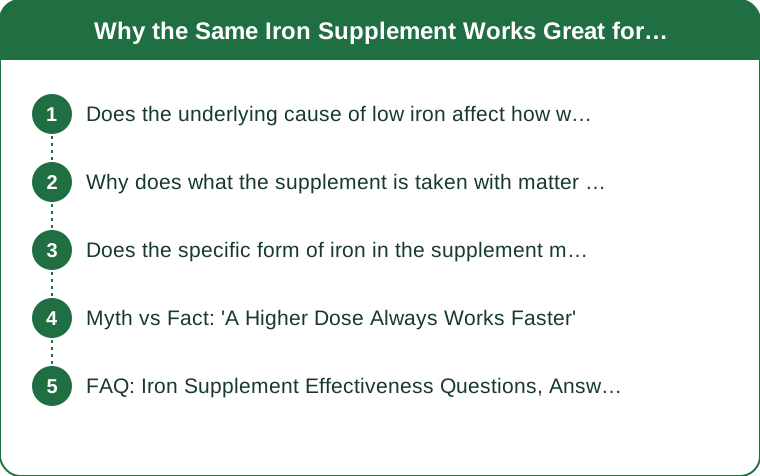
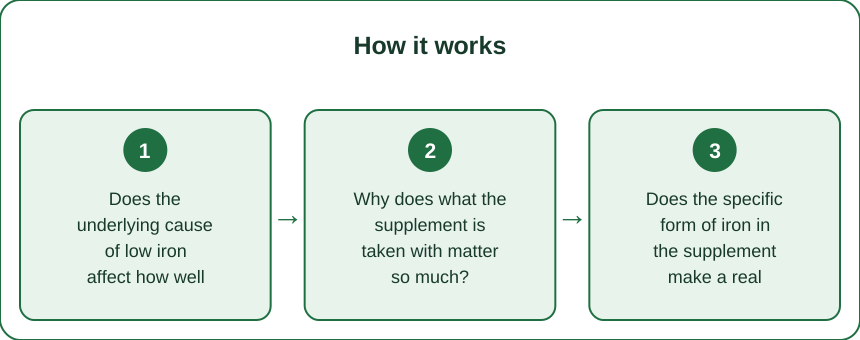
Does the underlying cause of low iron affect how well supplementation works?
Significantly — supplementation works best when the cause is straightforward dietary insufficiency or blood loss (like heavy periods), but is far less effective on its own when the underlying cause involves a gut absorption issue (like celiac disease or chronic gut inflammation), since the supplement has to actually be absorbed through the same compromised pathway causing the original deficiency.
Why does what the supplement is taken with matter so much?
Vitamin C significantly enhances iron absorption when taken together, while calcium, coffee, tea, and certain plant compounds called phytates can each independently block a meaningful portion of absorption if taken at the same time — two people taking an identical supplement but one with orange juice and the other with their morning coffee can see genuinely different absorption rates purely from that timing difference.

Does the specific form of iron in the supplement make a real difference?
Yes — ferrous forms (like ferrous sulfate or ferrous bisglycinate) are generally absorbed more efficiently than ferric forms, and among ferrous forms, bisglycinate tends to cause less GI discomfort while maintaining good absorption, which matters practically because GI side effects are a common reason people take a supplement inconsistently, indirectly reducing its real-world effectiveness regardless of the form’s absorption rate on paper.
Myth vs Fact: ‘A Higher Dose Always Works Faster’
Myth: if iron levels aren’t improving, taking a higher dose is the fix. Fact: the body’s iron absorption rate is regulated and becomes less efficient at higher single doses, meaning a very high dose taken all at once often doesn’t absorb proportionally better than a moderate one — some research even suggests alternate-day dosing improves total absorption compared to daily dosing, because it works with the body’s absorption regulation cycle rather than against it.
FAQ: Iron Supplement Effectiveness Questions, Answered
How long should someone wait before concluding a supplement ‘isn’t working’?
Most guidance suggests rechecking iron levels after 8-12 weeks of consistent use, since red blood cell production and iron store replenishment both take real time — checking too early often shows a smaller change than what’s actually still in progress.
Should iron supplements be taken with food if they cause stomach upset?
Taking with a small amount of food can reduce GI discomfort but does modestly reduce absorption compared to an empty stomach — for many people, the tradeoff favors consistency (being able to actually take it daily) over the small per-dose absorption difference.
Is it worth getting bloodwork before adjusting supplement type or timing?
Yes, generally — knowing actual ferritin and hemoglobin trends over time, ideally with a doctor’s guidance, gives a much clearer picture than adjusting based on symptoms alone, since fatigue and other low-iron symptoms can have multiple overlapping causes.
TL;DR:
- Absorption factors, not dose alone, explain most of the variation in how well iron supplements work
- The underlying cause of low iron (dietary vs. absorption-related) changes how effective supplementation can be
- Vitamin C boosts absorption while calcium, coffee, and tea can meaningfully block it if taken together
- The specific iron form used affects both absorption efficiency and GI tolerability, which drives real-world consistency
If a supplement doesn’t seem to be working, the timing and pairing around it are worth checking before assuming the dose needs to go up.
Keep Reading
This article is for general informational purposes only and is not medical advice. Always consult a qualified health professional for guidance specific to you.